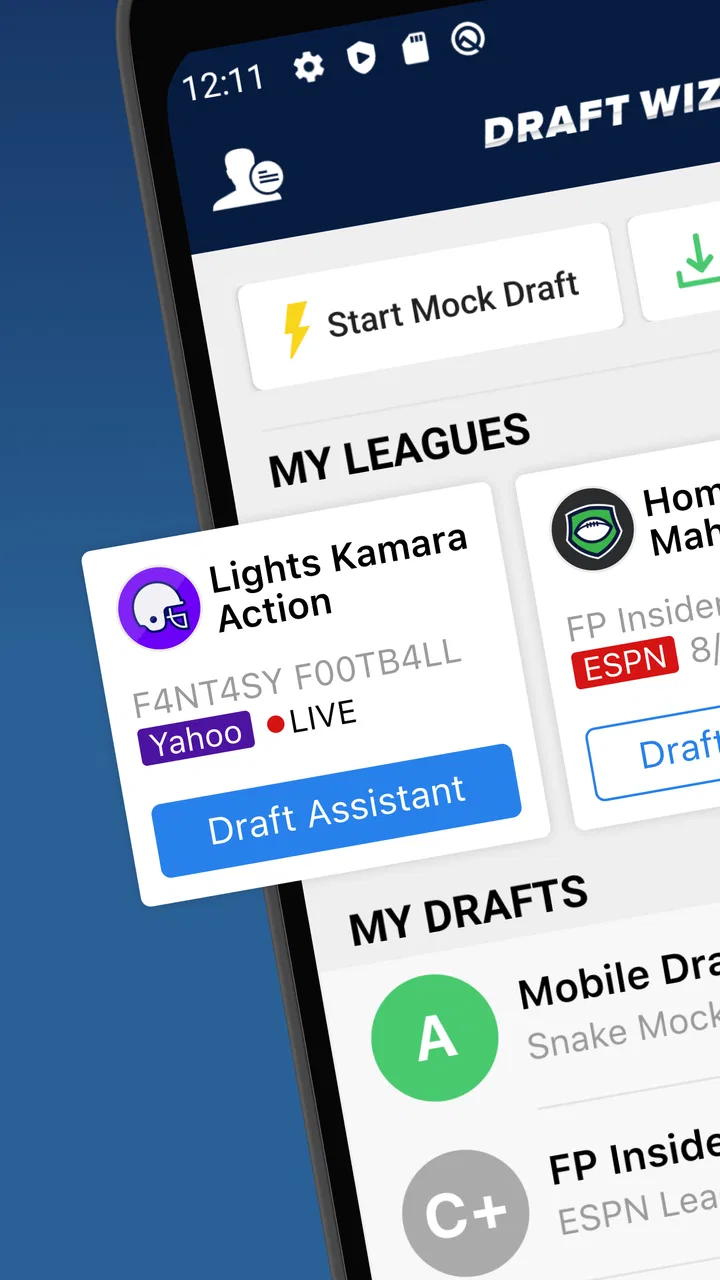
Fantasy Football Draft Wizard
- 4.6
- Rating
- 500.00K
- Installs
- Free
- Price

 Analysis by App-foxy
Fantasy Football Draft Wizard is the kind of sports app I would open before a fantasy football draft, not because it replaces every decision, but because it gives me a more organized way to make those decisions under pressure. Developed by FantasyPros, it focuses on the draft itself: preparing a plan, following player values, and reacting when the room starts moving in an unexpected direction. That narrow focus is its biggest strength.
I tested it with the mindset of someone who has used rankings, spreadsheets, and ordinary fantasy advice pages before. The difference is that a dedicated draft tool keeps the information connected to the moment when I actually need it. Instead of jumping between a league screen, a ranking page, and notes about roster balance, I can use one workspace to think through the next pick. For a fantasy manager who enjoys draft day but dislikes feeling unprepared, that makes a noticeable difference.
The app is free to install and is rated for Everyone, so it is easy to try without committing money at the start. It has built a solid audience, with an average rating of 4.6 from around 14 thousand ratings and more than 500 thousand installs. Those figures do not guarantee that it will suit every league, but they do match my impression that this is a mature, purpose-built tool rather than a quick companion app.
You May Also Like

 Blood Strike: 2.5 Anniversary
Blood Strike’s Loadouts Turn Every Drop Into a Tactical Gamble
A close look at Blood Strike’s custom loadouts: how fast access to signature weapons reshapes its battle royale rhythm, rewards preparation, and narrows the gap between fights.

 Pandora - Music & Podcasts
Pandora’s Music Is Easy to Start, but Harder to Recover
Pandora’s strength is its low-effort path from a seed to a station. Its weak spot is how much confidence it asks you to place in connection, setup, and quiet recovery.

 8 Ball Pool
 Is Built on Rivalries, Rematches, and Routine
A close look at the rivalries, rematches, shared routines, and unanswered safety questions that turn a quick pool match into a persistent mobile community.

 Samsung Music
’s Quiet Strength Is Playing What You Already Own
Its reach comes less from spectacle than from dependable access to a personal library. That simplicity is both the app’s strongest retention engine and its ceiling.

 AccuWeather: Weather Radar
AccuWeather Review: A Quick, Clear Forecast for Everyday Decisions
For everyday plans, the best forecast is the one you can understand quickly. AccuWeather makes rain timing, radar, and local conditions easy to act on, with a few trade-offs.

 Hill Climb Racing
Why Hill Climb Racing Still Turns Crashes Into One More Run
A tiny car, a bumpy hill and one more upgrade: Hill Climb Racing keeps resurfacing because its simple chaos makes every near-miss feel personal.
More From Our News Desk



Why the draft assistant matters more than another list of rankings
The central capability here is the draft assistant. That sounds simple, but its real value is not just showing names in an order. A ranking page tells me who is generally valued highly. A draft assistant helps me interpret that information after several players have already gone, when my roster has started to take shape and when the best available choice may depend on what I have already selected.
That distinction matters because fantasy drafts are not solved by taking the highest-ranked player every time. If I already have a strong group at one position, the next pick may be better used to address a thinner position or secure a player profile that will be difficult to find later. The useful part of Draft Wizard is the way it keeps the decision connected to the developing draft rather than treating every pick as an isolated question.
I also like that the tool encourages preparation before the room opens. I can think about how aggressively I want to pursue certain positions, where I am willing to take risks, and which players I would rather avoid. That preparation does not force me into a rigid script. Instead, it gives me a starting point, which is important because even a well-planned draft changes as soon as other managers make their first unexpected choices.
The practical benefit is reduced decision fatigue, not automatic league victory. I still need to understand my league settings, watch the roster I am building, and decide how much risk I can accept. The app helps me process those choices faster. It is an assistant, not an autopilot.
Using it before the draft begins
My most useful workflow starts well before draft night. I first look at the kind of roster I want to build, then use the available guidance to identify where I am flexible and where I am not. This is more productive than memorizing a long list of player names because it gives me a decision framework. If the first rounds do not go as expected, I can adjust without feeling completely lost.
A good habit is to create personal tiers or mental groups rather than relying on one exact ranking position. In practice, the difference between nearby players is often less important than whether I am about to lose access to an entire tier. When the app presents its recommendations, I use them as a signal to ask, “How many comparable choices will still be here after my next turn?” That question produces better picks than simply chasing the top name on the screen.
I also recommend checking the app while thinking about league-specific rules. Scoring settings, roster slots, and draft order can change the value of a player dramatically. A tool can organize the process, but it cannot make a standard recommendation fit a custom league automatically in my head. I still treat the league setup as the first filter.
Another useful preparation trick is to decide what would make me abandon my preferred plan. For example, I might enter the draft expecting to wait on a position, but I would change course if the available options fell below a quality level I had identified beforehand. This prevents emotional reactions. Rather than panicking because a favorite player was selected, I can compare the remaining choices with the plan I made earlier.
What happens when the draft is moving quickly
Draft day is where the app earns its place. Picks arrive quickly, conversations distract me, and other managers can create runs that make the room feel more urgent than it really is. Having a focused draft interface gives me somewhere to return after each selection. I can review my roster, consider the available options, and make the next decision without rebuilding my notes from scratch.
In a realistic evening scenario, I might be drafting from my phone while keeping up with a group chat. Another manager starts selecting players at the same position I planned to target, and suddenly my original route is gone. Instead of scrolling through a general fantasy website and trying to remember what I already own, I can use the draft view to reassess. The app does not remove the pressure, but it turns the pressure into a shorter checklist: what do I need, what is available, and which choice keeps my roster balanced?
This is also where I noticed the difference between a dedicated draft tool and a spreadsheet. A spreadsheet can be customized beautifully, but it demands preparation and constant manual updating. Draft Wizard is more convenient for someone who wants guidance without building the entire system personally. The trade-off is that a spreadsheet may offer more control for an experienced manager who enjoys designing formulas, tiers, and custom notes.
Compared with simply following a podcast or reading articles, the app is more immediate. Articles are useful for learning context and hearing arguments, but they are not always easy to apply during a live pick. I would use those sources for preparation and use the app for the actual sequence of decisions. Compared with a league provider’s built-in draft room, Draft Wizard feels more focused on strategy rather than merely recording picks.
The best use case: a prepared manager who still wants flexibility
The strongest scenario for this app is a live draft where I know enough about fantasy football to make choices, but I do not want to calculate everything manually. It is especially helpful when I have a general plan but expect the draft to disrupt it. The assistant gives me a reference point without demanding that I follow one exact route.
This makes it a good fit for casual-to-serious players joining a competitive league with friends, coworkers, or family. I can prepare in short sessions, return to the same draft strategy, and arrive with more confidence than I would get from opening a random ranking page minutes before the draft. It is also useful for people who play in more than one league and need a repeatable process rather than relying on memory.
For a beginner, the app can make the draft less intimidating because it narrows the number of choices on screen. However, I would not treat it as a substitute for learning basic roster construction. A new player still needs to understand why positional balance matters, how league scoring changes value, and why a recommendation may not fit a particular roster. The app can support that learning, but it cannot do the thinking entirely for the user.
One less obvious use is as a post-draft review tool for improving future decisions. After the draft, I can think back through the moments when I ignored the suggested direction and ask whether the decision was based on a real league need or simply on panic. That kind of review is more valuable than judging the whole draft by one player’s later performance. It helps me separate process from outcome.
Where the experience becomes less comfortable
The first trade-off is that recommendations can create false confidence. When an app highlights a player or direction, it is tempting to assume that the answer is objective. Fantasy football is too dependent on league settings, injuries, changing roles, and personal risk tolerance for any ranking system to remove uncertainty. I still want to know why I am making a pick, especially when the recommendation conflicts with my roster.
The second limitation is the need to stay attentive to league details. A manager who accepts suggestions without checking scoring and roster requirements may build a team that looks strong in a general ranking but is poorly suited to the actual competition. I consider this the most important user responsibility. The app can speed up the draft, but I remain responsible for translating general advice into my league’s rules.
There is also a subscription-related consideration. The app is free, but in-app purchases range from $7.99 to $191.99 per item. That broad range means I would look carefully at what is included before paying for anything. A player who joins one friendly league may get enough value from the free experience, while a manager who drafts frequently may consider paid tools more worthwhile. I would not spend simply because the draft feels stressful; I would first see whether the free workflow already solves my problem.
The mobile format brings its own friction. A phone is convenient, but a live draft can involve small text, quick scrolling, and interruptions from notifications or other apps. I found the experience more comfortable when I had already prepared my preferences and was using the app to confirm decisions rather than discovering everything in real time. If I wanted a large, highly customized command center, a desktop spreadsheet or browser-based setup might suit me better.
Finally, this is not the right choice for someone who dislikes structured advice. If my enjoyment comes from ignoring consensus rankings, making unusual roster bets, or building a personal model from raw information, the assistant may feel restrictive. I can still make my own choices, but the product is designed to guide the draft process, not to disappear completely into the background.
Small habits that make the assistant more useful
I get better results when I use the app in layers. First, I establish the league context. Next, I decide which roster needs are most important. Only then do I use the recommendations to compare the players still available. This order prevents the screen from dictating my entire strategy and makes the guidance more relevant to the team I am actually building.
I also avoid treating every round as equally urgent. Early picks usually shape the foundation of the roster, while later picks are better evaluated for depth, upside, and flexibility. When the app suggests a player late in the draft, I ask whether that player gives me a useful alternative or merely repeats a strength I already have. This is a simple question, but it stops me from collecting similar players just because they appear attractive individually.
Another practical tip is to prepare a short list of acceptable alternatives before the draft starts. If my preferred target disappears, I can move to the next option without searching from zero. Draft Wizard is most effective when I combine its guidance with that personal fallback list. The app supplies structure; my notes supply the preferences that make the roster feel intentional.
I would also keep a little distance from draft-day momentum. A run at one position can be informative, but it can also make everyone overreact. I use the app to check whether the remaining player pool actually supports chasing that run. Sometimes the better move is to take a different position while other managers remove options from one another’s boards. The tool is useful here because it gives me a calmer reference than the noise of the room.
Who gets the most value from it
The biggest winners are managers who want a repeatable draft routine. They may know the basics but lack the time to build a complete strategy every season. They can open the app, prepare around their league, and use the draft assistant as a live decision aid. It is also a strong fit for people who draft on mobile and want something more focused than switching among browser tabs.
Managers in several leagues may appreciate the consistency even more. When each league has different settings or draft positions, a structured tool helps reduce avoidable mistakes. It does not make every league identical, but it gives me a familiar process for adapting to each one. That is a quieter benefit than a flashy feature, yet it can make the whole hobby less exhausting.
Beginners can benefit if they treat the recommendations as teaching prompts. I would encourage a new player to ask why the app favors one option, then compare that suggestion with the roster and scoring system. Over time, this builds judgment instead of dependence. The worst way to use it is to click the first recommendation without understanding the decision.
On the other hand, highly experienced managers with their own rankings, projections, and spreadsheets may not need it. If I already maintain a detailed personal model and enjoy updating it, the app could duplicate work rather than save time. It may still be useful as a second opinion, but I would not expect it to replace a system I have deliberately built around a specialized league.
Device details and overall value
Fantasy Football Draft Wizard is a sports app from FantasyPros, released on July 25, 2016, and its current version is 4.1.19. It requires Android 8.0 or later. Those details matter mainly because this is an established app with a long enough history to feel like a continuing product rather than a temporary draft-season experiment.
The free entry point is a genuine advantage. I can test whether the workflow matches my drafting style before considering the optional purchases. The age rating of Everyone also makes it broadly accessible for households and leagues where younger players may be involved, although the strategic depth is aimed at fantasy managers rather than children specifically.
My final view is positive, with one clear condition: I would use this as a decision framework, not as a promise. Its best feature is the way it keeps draft recommendations connected to a changing roster, which is much more useful than staring at an unchanging list of rankings. It saves attention at the exact moment when attention is hardest to spare.
If I were recommending it to a friend, I would say this: install it if you want help preparing for a live fantasy football draft, especially when you need a flexible plan on your phone. Use the free experience first, check every recommendation against your league rules, and keep your own priorities visible. If you prefer total control or already maintain a sophisticated personal draft model, a spreadsheet or your own rankings may be better. For everyone in between, this app offers a practical middle ground between drafting blindly and turning fantasy football into a full-time research project.
FAQs for Fantasy Football Draft Wizard
01What is Fantasy Football Draft Wizard?
Fantasy Football Draft Wizard is a draft preparation and management tool designed for fantasy football players. It helps you practice mock drafts, compare player rankings, review projections, build personalized draft strategies, and make informed selections during a live draft. The app is mainly useful for users who want more structure than a standard league platform provides.
02Can I use Fantasy Football Draft Wizard for mock drafts?
Yes. Mock drafting is one of the app’s main features. You can select league settings such as roster size, scoring format, draft position, and number of teams, then practice against simulated opponents. These sessions can help you understand positional runs, identify value picks, test different strategies, and become more comfortable making decisions under a time limit before your real fantasy draft.
03Does Fantasy Football Draft Wizard support different league formats?
The app is intended to support a variety of fantasy football formats, including common standard, half-PPR, and full-PPR setups, as well as different roster configurations and draft types. However, available options may depend on your subscription, platform, and the league provider you use. Check the settings carefully and confirm that they match your league before relying on the recommendations.
04Can Fantasy Football Draft Wizard be used during a live draft?
Fantasy Football Draft Wizard can be useful during a live draft because it provides rankings, projections, player comparisons, and draft recommendations while you make selections. Its exact level of integration may vary depending on the supported fantasy platform and account plan. Even with live assistance, you should verify league settings, injury news, and roster needs rather than following every suggestion automatically.
05Is Fantasy Football Draft Wizard free to download and use?
The application may be available to download without an upfront charge, but some advanced tools and premium content can require a subscription or in-app purchase. Free access may include limited rankings, mock drafts, or basic features, while paid plans can unlock more detailed projections, customizable strategies, and additional draft support. Review the current pricing and trial terms before subscribing.
Pros
- Fast mock drafts help you practice different draft strategies.
- Custom league settings make projections more relevant to your format.
- Player rankings and tiers are easy to scan during draft preparation.
- Useful draft analysis highlights reaches
- values
- and roster balance.
- Supports multiple fantasy sports
- not just standard fantasy football.
Cons
- Many advanced tools require a paid subscription.
- The large amount of data may overwhelm first-time fantasy players.
- Projection accuracy can vary widely from one player to another.
- Some features depend on current league or player data syncing correctly.
- Mobile navigation may feel crowded on smaller screens.

Fantasy Football Draft Wizard
Gallery